
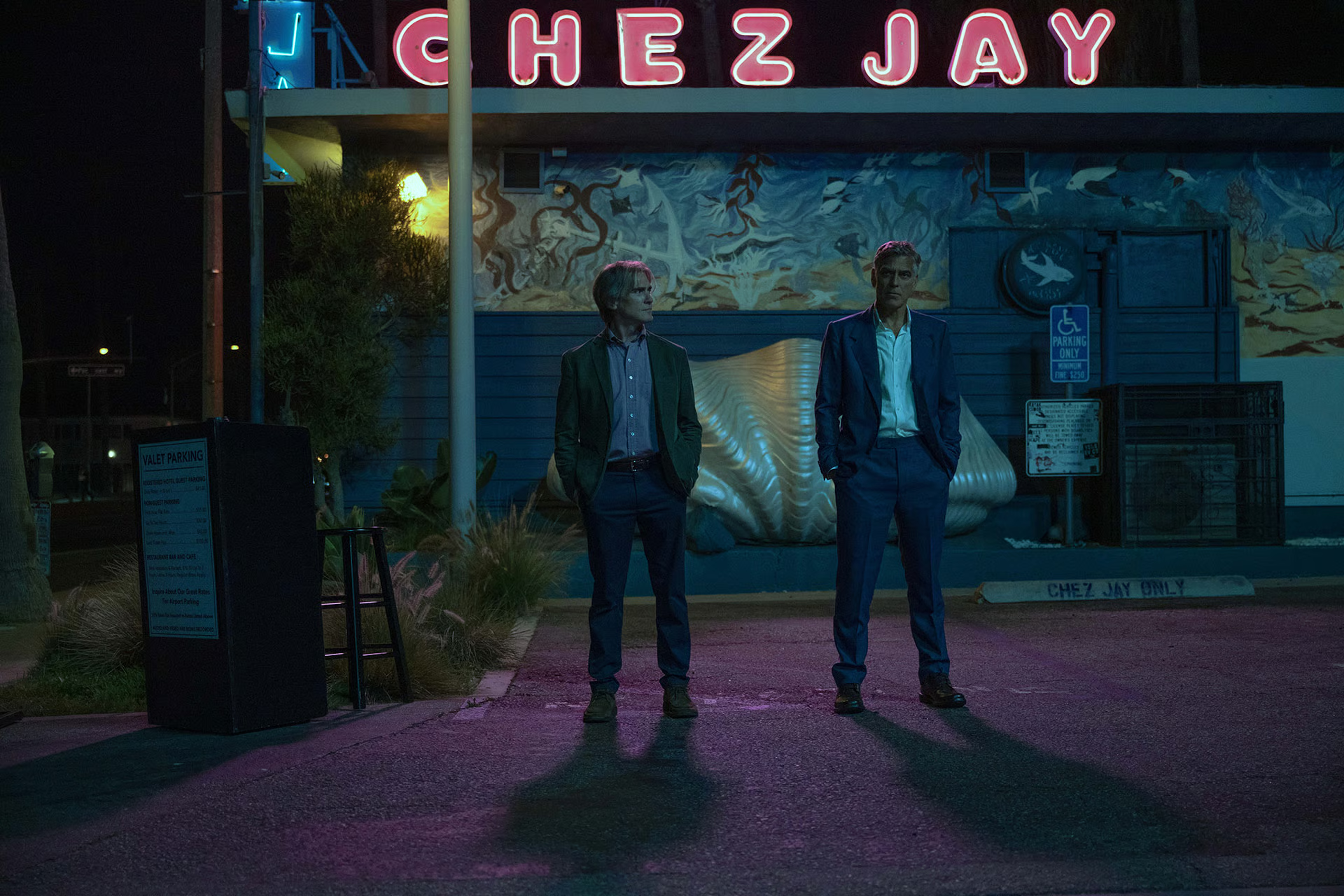
Jay Kelly (George Clooney) finds himself in an old haunt he used to frequent with one-time roommate and old acting classmate Timothy (Billy Crudup). Already in a wistful mindset after the death of the man who gave him everything, Jay isn’t really feeling like one of the all-time great movie stars. It’s in Timothy that he hopes to find a shred of peace, if only for a moment. Perhaps a bit of normalcy is all that’s needed for Jay to get his head right again. And so, it all falls on Crudup to deliver not just a powerhouse single-scene performance, but the moment which, in retrospect, defines the entire crux of Jay Kelly. Noah Baumbach’s latest film, celebrating its New York premiere at the 63rd New York Film Festival, is a sort of homecoming for the beloved New York filmmaker. Ironically enough, this film has little to do with New York, opting instead for a globetrotting hero’s journey of sorts. Jay Kelly isn’t necessarily a hero, but he’s certainly seeking a lost part of himself. And all the while he’s wondering if it was ever there in the first place.
Though Timothy has said he gave up acting long ago, Jay insists he pulls out the acting trick which enamored their class once upon a time. Crudup obliges the star, and reads a menu laid out before him. The first read-through is completely devoid of emotion. The second channels a memory which brings Timothy to tears as he delivers the menu options with a deeply emotional outburst. Alongside cuts to Jay’s excitement, it’s an incredibly funny scene and fully indicative of how strange and performative the entire concept of cinema is. Here is an emotional response which is a complete and total fabrication for Timothy. Yet what Crudup and his character are doing is undeniable. It’s such an effective performance that it’s able to elicit a completely different emotion than what tears normally bring out of an audience in the presence of a dramatic reading: laughter and wonder. How can somebody be so moved by something so unquantifiable? Despite a clear expression of emotion, it begs the question whether any of the emotions wrapped up in the movie business are real to begin with. To that, it feels like the answer is simply: how could it not be?

Jay Kelly is a man who has been seen by everyone yet feels completely unseen in many ways. When he looks in the mirror, does he see himself? Or does he see the idea of his movie stardom standing amongst other acting legends? The film opens on a quote from Sylvia Plath claiming, “It’s a hell of a responsibility to be yourself. It’s much easier to be somebody else or nobody at all.” With that in mind, despite Jay Kelly’s superstardom and elite status, he becomes instantly relatable on a human level.
Is it not common for any of us to completely pour ourselves into our hobbies or surroundings in the hopes of drowning out the noise of daily life? To live is to experience the same series of anxieties and worries and fears as anybody. And so, we find ways to spend the time and lose ourselves within those distractions. In the case of Jay Kelly, he spent the bulk of his lifetime distracting himself with cinema and the glamour of stardoom. And throughout Jay Kelly, Baumbach explores the distractions that made up Jay’s life with an intense longing. There’s an aching quality to the imaginative moments Jay finds himself getting lost in during his travels across Europe. These sequences are staged so delicately by Baumbach. He explores the enigmatic internal driving forces of his fabricated movie star by blurring the lines between fiction and reality. We learn of Jay’s many faults and worries over the course of the film through the simple beauty of classical movie magic.
With a seamless transition from reality to imagination, going from set to set in one fluid take, Jay finds himself transported from a train or a plane to that of an old movie set or an audition room. As Jay makes it clear early on in the film, “All my memories are movies.” Despite Clooney portraying a mega-successful star, is this not something any of us cinephiles can relate to? He remembers formative moments of his life through movies because he was grappling with the real-world emotions they actively brought to the surface. For those of us watching through the screen, do we not remember past experiences of all sorts through film? Fiction and reality may be separated by a screen, but they’re also inextricable from one another in our minds and hearts.
Perhaps we’re moved by art because the most powerful examples of it remind us of what we’re hiding away from. There’s an artifice to cinema, but the greatest examples are mined from the personal. It’s where the emotional resonance of a great film often stems from. It’s not solely the fact that we find a story compelling or an image evocative. Once we as viewers absorb the culmination of a filmmaker’s work, it allows us to reckon with our thoughts and views and feelings about the subject in question. Jay is now facing this all at once in the midst of receiving a tribute for his achievements in cinema. It’s an incredibly fitting example of meta-casting that works in Baumbach’s favor. The camera simply loves Clooney, who turns in a breathtaking performance. The gravitas he brings to Jay Kelly is undeniable, and his charisma as the titular star speaks to why he’s one of the greatest movie stars to ever grace the big screen. It’s that weight which makes Jay Kelly as effective and internal a drama as any of Baumbach’s other films.
Forget the stardom of Jay; it could be argued his riches and status are irrelevant to the story. Simply put, Jay Kelly is all about its titular character reckoning with whether or not any of it was worth a damn. The result would appear that it both was and wasn’t. That’s the entire conundrum of Baumbach’s and co-writer Emily Mortimer’s script. It’s an expressionist film which sees Baumbach operating in a register of less grounded realism. The shift certainly takes some getting used to. But of course, this film is oftentimes very raw and vulnerable in typical Baumbach fashion. Regardless of the approach taken to the subject matter, this is still a film about an individual lost in the cacophonous noise of life. For Jay, that noise is amplified by the lives of every character he’s ever played in a film. This makes the examples of blurring the lines between fiction and reality all the more exciting. And isn’t that what cinema is all about? We take the moments of our lives that make us who we are, whether consciously or subconsciously, and project them onto a series of images we experience through a screen. It’s an artform that asks so much of its audience, but it in turn provides us with such catharsis and wonder. We can be happy or sad with how life played out. We can be proud of all our accomplishments and achievements, yet still desire something that is the final missing piece of the puzzle. Getting to the peak of a mountain could cause us to look back where we came from and wonder what’s going on way down below. The beauty of where we are and the wonder of what we left behind can, and do, co-exist. Jay Kelly actively reckons with co-existing in the space between the two. It’s not something that makes us greedy; in fact, it just confirms the natural curiosity and panic of being human. Wouldn’t we all consider, even for a moment, giving this whole big journey of life another go-around if provided the opportunity?
Jay Kelly celebrated its New York premiere at the 63rd New York Film Festival as part of the Main Slate section.