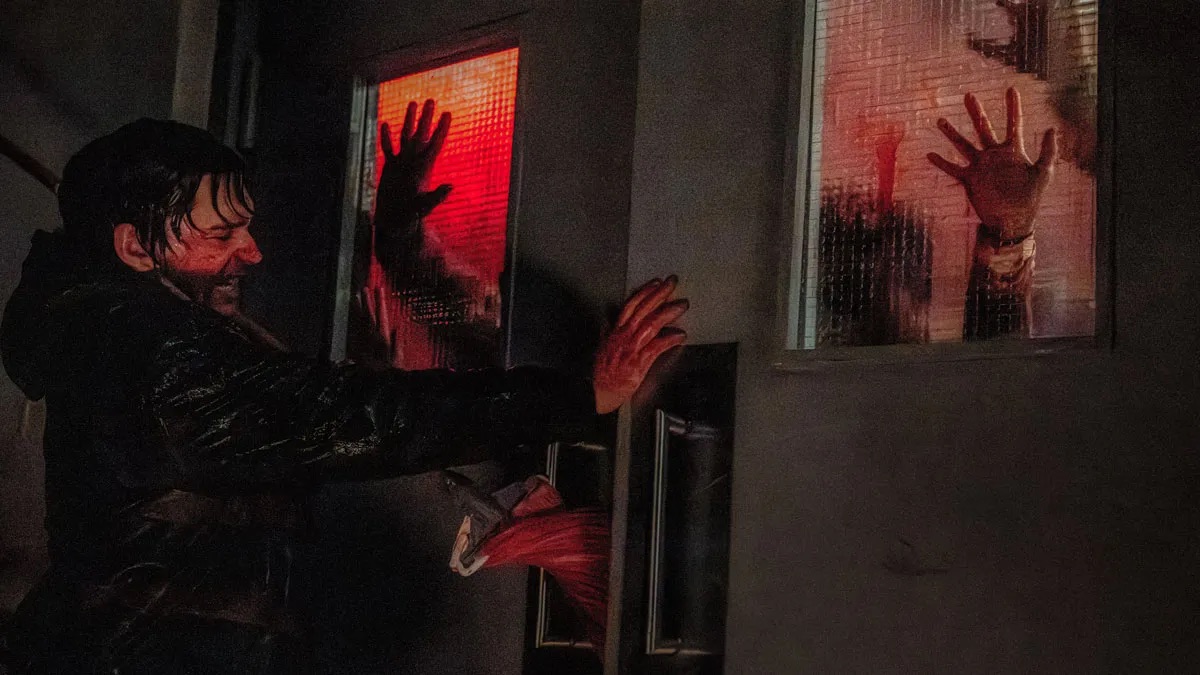
Resident Evil, the latest film from Zach Cregger, does something so few IP adaptations today shy away from. It wholeheartedly embraces its source material rather than feel embarrassed by its origins. Ignore all the “fans” of this legacy franchise claiming it’s inaccurate or disrespectful or whatever bad-faith hill they choose to stand atop while screaming at the clouds. Resident Evil is the real deal in every sense of the word. For everybody else in the world, whether they’ve played every game in the franchise, or have never experienced the terror of encountering Nemesis in the streets of Racoon City, their first Licker in an underground laboratory, or the famously horrifying first zombie looking over its shoulder in the Spencer mansion, Cregger delivers a film which perfectly delivers on the promise every Resident Evil game has made to its players for decades: to scare us beyond our wits. But Cregger isn’t just making another horror film based on IP for the sake of it. He’s making a film that hinges upon video game logic and stylization, all the while never sacrificing cinematic beats that work time and time again. He melds the best aspects of both mediums, and the film soars because of such crucial decisions.
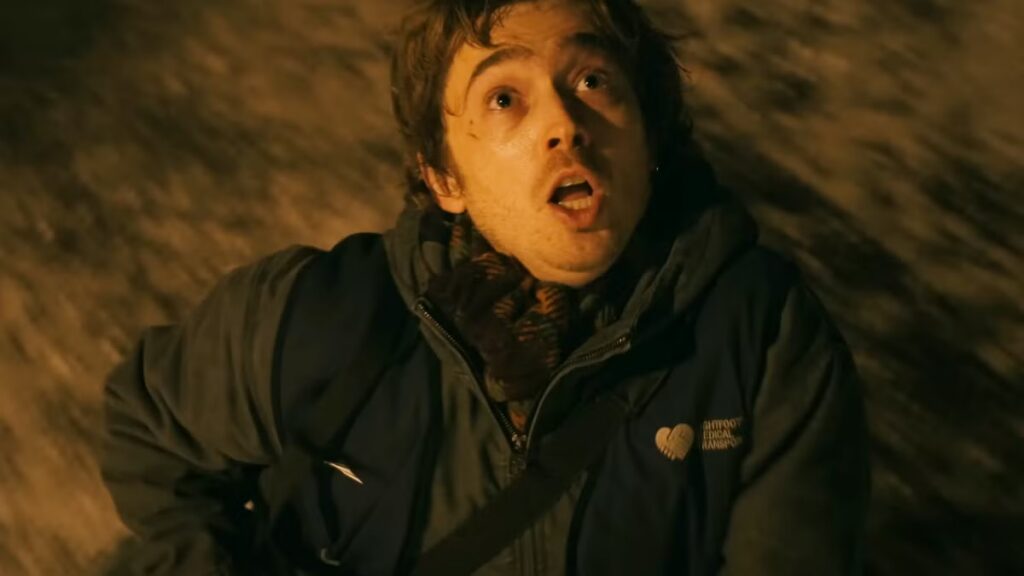
It only takes Cregger and co-screenwriter Shay Hatten a few moments to establish the driving force of this film. Bryan (a wonderfully dialed-in Austin Abrams) is a medical courier who would much rather brave the elements and the unknown for a few extra bucks than deal with the most pressing issues of his life at home. Despite his seemingly wishy-washy demeanor, he does appear to have some sort of ethical backbone; although we also come to quickly learn that it, too, can be bent if necessary. And from there, Cregger sets the stakes of his film in motion and sends his audience into the hellish circumstances of a Resident Evil story. Our protagonist is driving headfirst into Raccoon City, completely unaware of the torment that’s waiting for him. And that’s ultimately what Resident Evil feels like; a gleeful exercise in causing distress to an unwitting individual. Cregger has cast the affable Abrams, coming off a similarly stunning performance in Weapons, as a character who exists almost solely to torture through a consistently escalating series of dilemmas. And dishing out all this would be so frustrating and sad if it wasn’t so unbelievably funny. There’s no denying Cregger’s impeccable ability to deliver surefire scares through genuine moments of horror. He can induce simmering dread in an instant, or cut right to the bone with top-notch jump scares. But time and time again, Abrams’ bewilderment and denial at his present circumstances make for an ever-improving series of perfectly-executed comedy beats. The ways in which his logical problem-solving falls completely flat, or his attempts of brute force lead to an even messier situation, just works every time. And beyond just being a well-constructed manner of setting up a joke, it’s in these sorts of instances wherein Cregger utilizes video game logic in wonderful ways.
For example, on more than one occasion, Bryan comes up against a strikingly-designed padlock without a key in sight. His attempts to break through of his own volition rather than find an alternate way around the path set in place by the script are met with worse circumstances. It’s no different than trying to utilize a glitch in a video game, only to break the environment entirely, forcing a reset. Real-world logic is damned in favor of horror or comedy here, and it steeps the electrically-charged runtime of Resident Evil into genuinely unnerving waters with consequences.
Bryan’s attempts to break free of his increasingly worsening circumstances only make things more severe for him, and he’s punished because of this behavior. The path forward shouldn’t always be easy. And to try and take shortcuts only increases our chances of being made a fool, or in Bryan’s case, being made into something much, much worse. Building out this logic so early on in the film allows for really wonderful moments the longer Bryan’s attempted delivery plays out. Whether they be cathartic or intentionally frustrating, Cregger seems to always have his finger on the pulse. Because of this acuity, he knows how to amplify any situation through brilliant direction.
It’s equally exciting to see Cregger utilize a variety of cinematic styles and tones in his favor to better the film in any given moment. Take the initial horror set piece of the film as an example. When it begins, it’s the dead of night and there’s not a light to be seen aside from what’s on screen. Cregger uses this pitch black void to generate effortless scares. But the transition to the next outstanding extended set piece requires a bit more light. And so, the sky is magically a bit brighter and Bryan can see almost everything he needs to see. It’s not reality breaking, but it is instead bending the whim of reality around whatever the film needs most at that time. It’s indicative of a filmmaker knowing exactly what any given scene requires, and utilizing it to its full potential. It’s felt through all the varying visual languages Cregger and cinematographer Dariusz Wolski utilize as well.

Whereas the (great) Paul W. S. Anderson’s Resident Evil films would often rely on fixed camera angles as a way to mimic the style of the earlier series entries, Cregger’s visuals pull their language from the more modern games in the franchise. Beyond Cregger’s standard fluidity of movement, he’s effectively making use of both first-person and third-person POVs whenever a moment deems it most vital. What better way to amp up the claustrophobia of a cramped environment than by only allowing us to see the barrel of a shotgun practically touching the walls directly surrounding our lead (and virtually only) character? It feels like a glorious victory every time Cregger successfully pulls it off. And before we know it, Bryan is running throughout the alleys of Raccoon City, camera chasing him yet always keeping him within the hellish frame, and it is beyond discombobulating. His night is only getting progressively worse, and this consistent dread caused by the worst day imaginable luckily makes for some strikingly entertaining, and incredible looking, cinema.
At 95 minutes, Cregger allows Bryan and his audience basically no time to breathe whatsoever. There are moments of respite, but they largely stem from a sobering place of reality crashing down atop Bryan, or for fun moments of exposition. Some may bristle against this, but I’d argue it’s no different than a standard organic lore dump in a video game. It’s not necessarily clunky as much as it is merely part of the DNA of this type of storytelling. It certainly helps to have a small, but mighty, cast of supporting characters showing up for a single scene to deliver exactly what is needed, only to then get out before we even realize what’s happened. Cregger and Hatten appear to have trimmed this script down to the bone, but it rarely feels hollow. It just seems to have the pure desire of captivating its audience early on, and then refusing to let go until the excellent final moments. In achieving that goal alone, Resident Evil should be considered a wild success, and unquestionably one of the best movies of 2026.