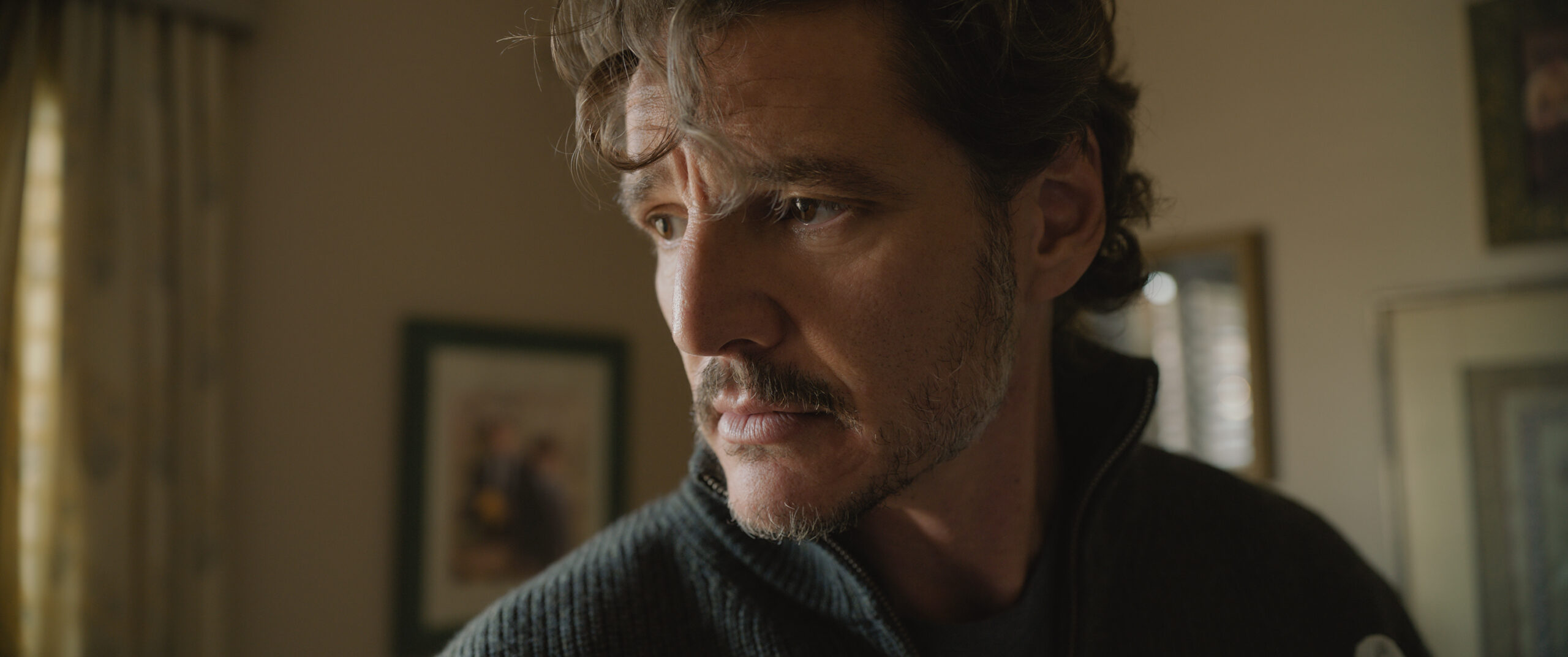
As if Tony Gilroy rejuvenating the Star Wars Universe with Andor wasn’t enough, it would appear that he’s doing the same for the contemporary adult drama film with Behemoth!. The Centerpiece film of the 64th New York Film Festival, Behemoth! is a brilliant deconstruction of a man’s life, told through moments of reflection rather than provide a straight-forward image of the individual at the center of it all. Even with such fragmentation of memory and time, Alex Serian (Pedro Pascal) still feels like a rich, deeply lived-in character. The second Gilroy introduces us to Alex is telling enough that he’s anything but one-note. As Alex prepares his cello for his latest session of film-scoring, countless players in the ensemble incredulously approach him with wonder of when he made it back into Los Angeles. The common niceties are exchanged, and Alex seems gracious to be remembered fondly, yet a deeper look at Pascal’s face reveals the signs of a man overwhelmed. Everybody wants a piece of Alex, when perhaps all he wants is a moment of peace and quiet before giving himself over to the music. Behemoth! eventually delivers both its character and audience just that desire. Once the musical jargon and technical specificities of the work are conveyed, the initial notes of music from The Behemoth Collective (the super-group of composers who provided music for the film) comes into play and effectively sets up the entirety of the film’s tone in one fell swoop. The music begins playing, and the uplifting score causes the camera to practically levitate until the viewer might also feel like they too could begin to float away. It’s the magic of the movies, or any form of art really, at its most pure. It works to stellar effect when setting up the connection between music and emotion.
From that introductory note moving forward, the film effectively belongs to the original score composed by The Behemoth Collective. Made up of 9 top-notch composers, they form a collective unit that fundamentally affects every single scene of the film. Now, it might indeed seem obvious to note that music plays an integral part in achieving the overall effect of a film. But the work Gilroy has compiled from this collective is something marvelous. The set tone of the film shifts wildly from scene to scene. A particular composer’s involvement in any given moment can make the film feel all the more radical. In exercising the freedom of this framework, Gilroy has crafted a film that is anything but standard, even if this is ultimately a character drama. Simply allowing Behemoth! the ability to operate in any register Gilroy or the composer sees fit allows it to transcend basically any expectations an audience might have for it. It morphs from thriller to romance to slapstick comedy to espionage action, all the while retaining a consistent through-line of realistic, human-based drama which grounds everything around it. During a press conference for the film, Gilroy expressed his admiration for music so passionately. There was a palpable excitement pouring out of him regarding all the potential music can provide anybody. That thrill is felt in the very DNA of Behemoth!. And one observation he made particularly feels crucial to the entire essence of this film. In discussing the rooms where film-scoring occurs, he noted the complete disparity of every individual that can make up the orchestra. And yet, the moment the music begins, he referred to them as forming “an organism.” It’s a beautiful embodiment of the unifying nature of art, as this “organism” has been birthed in the moment of creation and can morph into whatever is specifically needed within a moment.
That ability art has to shape-shift is what drives Behemoth! and all its varied tones and registers. And so, Behemoth! continuously delivers a masterclass in both musical precision and tone setting. With each composer of The Behemoth Collective leaving their distinct imprint on a particular moment or scene, the film finds an innate ability to thrum to the pulse of its own idiosyncratic beat. With Behemoth!, Gilroy effectively gives himself and his cast complete freedom over depicting life for all it contains. There are moments of transcendent beauty, suave charisma, deep-rooted trauma, passion, pain, and so much more. Pascal takes on this challenging role by diving headfirst into Alex and all his multi-faceted traits. This feels like it must be Pascal’s best performance, if only because of how lofty the requirement is in order for this entire film to work. Without Alex feeling like a character that can both remain rooted in his frustrating ways, while also showing a genuine evolution over the course of the film, none of Behemoth! would work in a meaningful way. All this music which drives Alex’s pace, his decisions, and the tones of the film speaks to some of the many multitudes contained within a single life. Beyond operating as a well-oiled, deeply entertaining piece of filmmaking, Behemoth! is so richly effective in this regard.

This is a story told within a series of vignettes. They are merely moments from Alex’s life being brought to fruition by the music around him. It’s through this framework that music plays such an integral part in the very structure of Gilroy’s screenplay. Gilroy capitalizes on music’s distinctly transportive qualities to gently guide the viewer through Alex’s flashbacks. It’s entirely absorbing, with each new scene expanding the scope of Alex’s character while fleshing out a wonderful ensemble of characters surrounding him. The intensity of Alex’s fling with Nadia (Eva Victor) is full of potential, passion and heartache. Alex’s relationship with his brother, Andy (Will Arnett), is seemingly fraught with sibling rivalry, and perhaps more than an undercurrent of loathing frustrations, but obvious love is always lurking amidst their bickering or banter. Carol (Olivia Wilde) enters the film like a runaway train primed to explode, and delivers a high-wire performance designed to immediately captivate and drop jaws from the sheer incredulity of its arrival. Each performer is delightful in their own right, and further imbues Behemoth! with the essential qualities of a film dedicated to delivering an honest yet colorful portrayal of the human condition. Importantly, the more heightened elements of the film never take away from its poignant reflections on reality.
Beyond the immediate inner circle of familiar faces in Alex’s life lies an entire world of professional peers, potential pupils, and those who can appear in our lives offering the opportunity of a potential second chance. Alex has seemingly lost his passion for the only thing he has known in life, reducing the arts to mere gigs to pay the rent. Behemoth! astutely captures the all-too-real feeling of being shackled to something we adore. If this passion is all that we know, what happens when it starts to feel too weighty to carry any further? Is endlessly running away the only solution? Alex seems to have felt that for quite some time. Yet Behemoth! quite beautifully explores the possibility of a much more fulfilling solution. If Gilroy’s 2007 masterpiece, Michael Clayton, is about the hollow aftermath of achieving a singular goal which drives us, his latest film feels much more hopeful in its potential for a revitalizing rebirth brought forth through inner rediscovery. This film, perhaps above all else, is a dedication to the arts and humanity itself. A character tells Alex “Thanks for being human” at one point. Within all the multitudes we contain, the self-sabotage, the worries, the triumphs, the ugly and the beautiful, lies an ingenuity and resiliency that cannot be replicated in any other fashion. It’s simply all part of the human experience, of which Gilroy’s Behemoth! embodies and conveys to its audience in spectacular fashion.
Behemoth! celebrated its World Premiere as the Centerpiece film of the 64th New York Film Festival.