Upon witnessing the bonkers finale of Danny Boyle’s 28 Years Later, audiences were left gobsmacked at what could possibly be coming next. But there was also a fair amount of trepidation afoot. This was the first film in a supposed trilogy, all penned by Alex Garland, but directing duties on these back-to-back films were split between Boyle and Nia DaCosta. Still, the thought of more made for an enticing prospect regardless. Despite still not having official release date confirmation of the third film in this sequel-trilogy, fans of Boyle and Garland’s need not worry any longer. Even if Boyle’s 2025 film stood alone, we’d have considered ourselves incredibly well fed. With the release of DaCosta’s sequel, 28 Years Later: The Bone Temple, it’s as if we’re being treated as gluttons of the highest order. Picking up nearly immediately after the insanity of the previous film, The Bone Temple feels familiar; but DaCosta’s film is still plenty liable to constantly keep her audience on edge, shocked, and highly entertained in equal measure.
These films have excelled for a number of reasons, but they have separated themselves as such fascinating objects in cinema with the formation of this hopefully soon-to-be trilogy. It almost feels as if there’s an apparent necessity at the core of each mainline entry to extend itself far beyond the likes of familiar zombie apocalypse films. Perhaps most prevalent is the strange exploration of themes and idiosyncrasies of ideas within which all these films operate. For example, there was much discourse about the baffling nature of the final moments of 28 Years Later (it’s an incredible sequence, and don’t let anybody convince you otherwise!). For those who step into The Bone Temple worried that DaCosta wouldn’t attempt to match that absurdist energy, have no fear. The eccentricities promised are delivered front and center through the likes of “Sir Lord Jimmy Crystal” (an unhinged Jack O’Connell) and his previously-met band of Jimmy acolytes. The ragtag group of psychotic individuals take up one half of the spotlight, and their behavior immediately sets The Bone Temple off on an off-kilter angle. The echoes of Jimmy’s cackling and prophetic insanities echo amidst the halls of an abandoned indoor water park in the introductory sequence. The eeriness which permeates through the entire franchise is wonderfully crystallized in such a setting. And it’s here where DaCosta wastes no time throwing her audience right into the deep end. She and Garland ensure the audience will rarely ever know what words are going to come out of O’Connell until he’s shouting them with chaotic glee. And before we even gain our bearings, much like Spike (Alfie Williams) is attempting to do his newfound clan, there’s blood spewing everywhere and we’re powerless to stop it. This sense of powerlessness, and clashing up against it, is an idea The Bone Temple consistently revolves around.
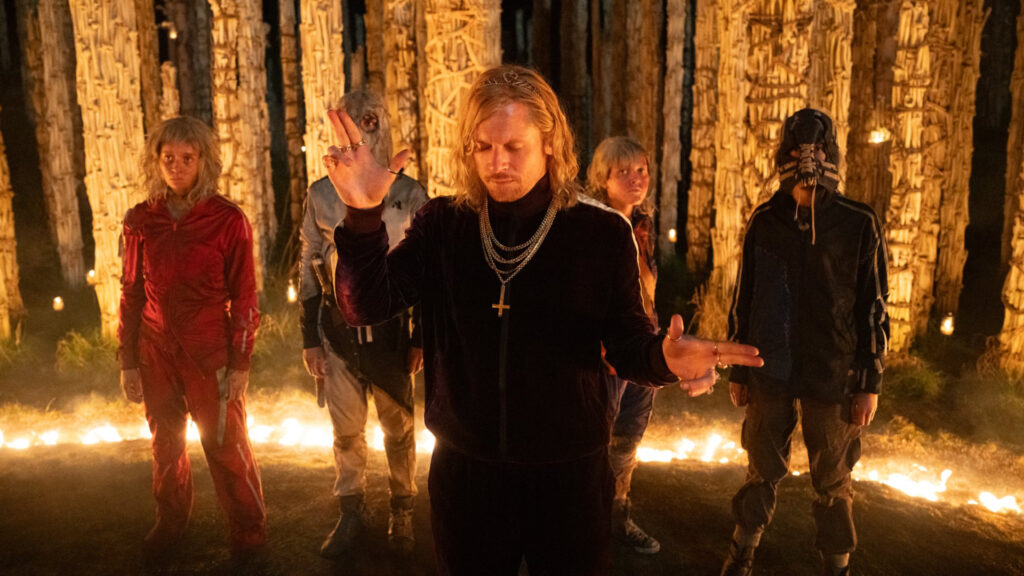
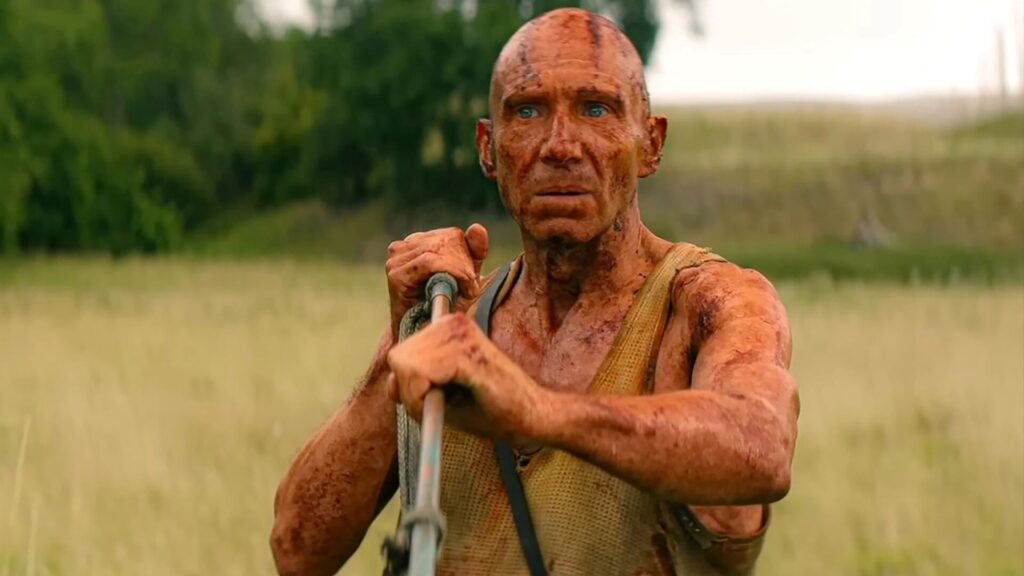
Where we find Spike being unwillingly inducted into the cult of Jimmy, we see how cruelty begets nothing but more brutal pain and suffering. It’s a shocking reminder that this franchise has rarely ever pulled its punches when it comes to inflicting violence upon the remaining survivors of the Rage Virus. Yet, despite its impressively entertaining penchant for genre-fueled violence, The Bone Temple, much like its predecessor, has so much more to offer its audience than hollow horror. The ideas presented in the previous film are explored even further here. But Garland is also expanding this world in ways that aren’t just clever and bold; they’re deeply moving and wildly effective. While experiencing O’Connell’s maniacal performance as Jimmy brings a constantly panicked vibe to the film, Dr. Ian Kelson (an impeccably dialed-in, perfect Ralph Fiennes) brings a crackling, yet touching, energy to The Bone Temple. Kelson is still up to his usual post-apocalyptic errands: building his titular ossuary, coating himself in iodine to provide a functional and instantly iconic character look, and dealing with his constantly nude neighbor, Samson (Chi Lewis-Parry), the Alpha infected from the previous film. And amongst Kelson’s and Jimmy’s day-to-day activities is where The Bone Temple excitingly focuses itself on the space between their two opposing views within the world around them.
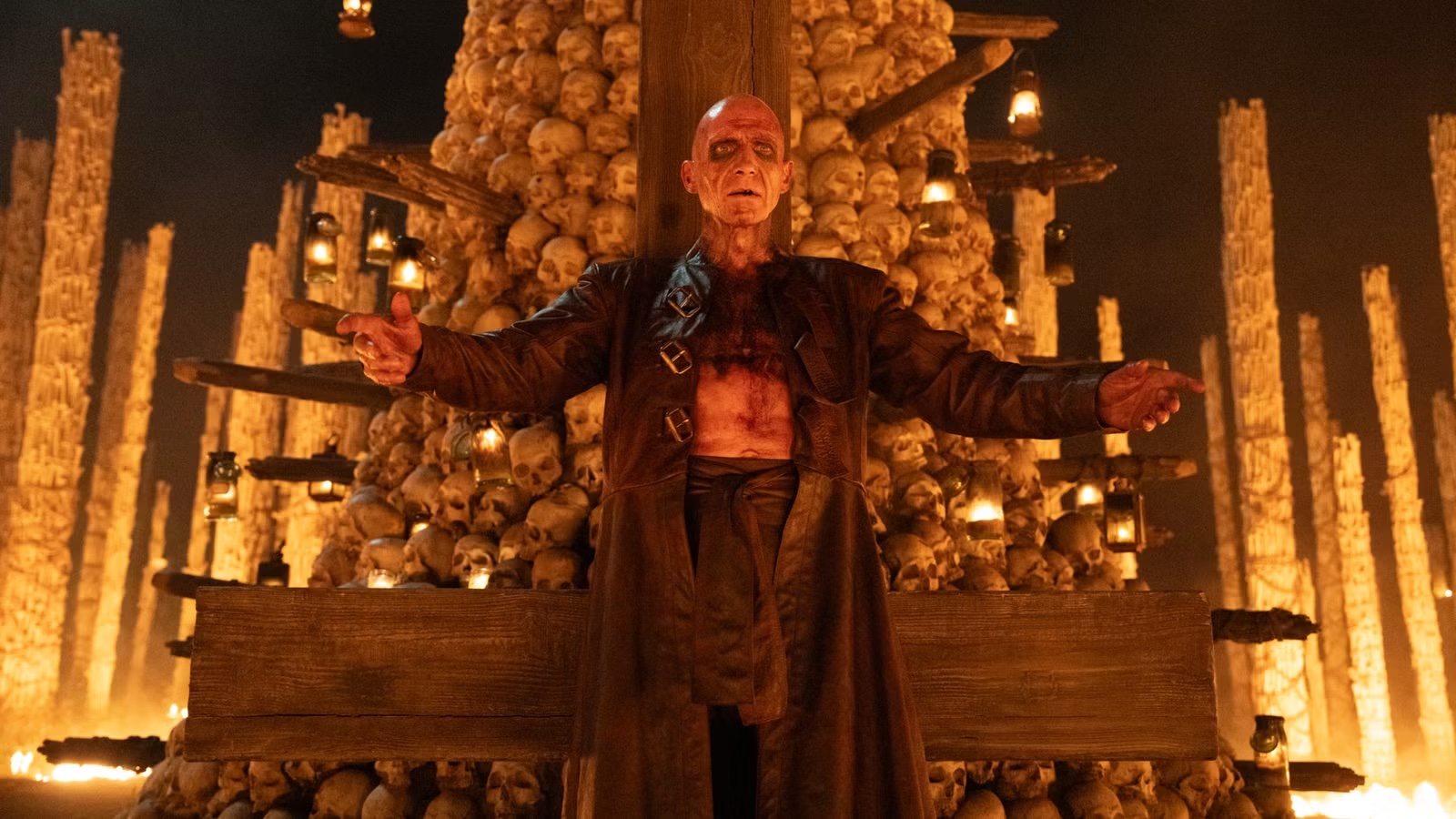
Jimmy exists to share his pain with anybody who might cross his path. The tragedy and horror in his childhood has broken him, seemingly irreparably. In an attempt to drown out the noise of his immense anger and distraught mental state, he lashes out at the world around him. Perhaps he feels the only way to not hear his own internal rage is to create a cacophony of louder anguish. It’s a caricature of evil, post-apocalyptic human behavior we’ve largely seen before. But O’Connell delivers it with such psychotic gusto that one can’t help but be enthralled by it. It’s in the film’s treatment of Samson and Kelson that The Bone Temple morphs into a different beast entirely. The key art for The Bone Temple has focused on a particularly insane-looking Fiennes shouting into the night sky. There’s no getting around the fact that he’s lost his mind in his own distinct manner. But in quite the twist on expectations, his character was revealed to be a vulnerable, empathetic figure in a world that largely snuffs out such characters. So this particular look seemed quite an enigma, but before revealing its thrilling context, The Bone Temple opens up fully to explore the potential for peace and quiet within a world made up seemingly exclusively of abrasive, cruel, and downright evil behavior.
Whereas Jimmy spreads pain, Kelson exists to ease it. In his attempts to rationalize the state of his life, he forms an absorbing relationship with Samson. What initially feels like somebody training and caring for an animal morphs into a lonely soul seeking to aid another lonely soul. This transformation makes for a number of sequences that are as irresistible to ponder as they are deeply funny to watch play out. Importantly, the dry British wit present in The Bone Temple never undercuts the dramatic or horrific stakes laid out. But this is also quite a funny film in several ways. A number of sequences lean into the absurdity of the situation in a way that’s truthful and never ironic. It’s deeply refreshing, and indicates a trust in the audience on Garland and DaCosta’s part. They understand that we buy into this world, and this allows them the freedom to explore whatever avenues they’d like in any way they please. Perhaps the most affecting of which is the ultimate question on whether or not we can find peace in such discordant times.
We simply wish for the world to be a bit more serene in order to appreciate the beauty it can offer. Utilizing a jolting switch of POV at one point early on in the film, DaCosta frames those infected with Rage in an entirely new light. This shift in thinking allows for later explorations of how badly we all simply want a moment of peace and quiet. It’s conveyed as an absolute necessity. To think of all the beauty and normalcy being missed due to the pain and chaos surrounding us feels like a fundamental cruelty. There is an inherent ugliness within the world, and that’s something The Bone Temple never shies away from. But despite that, it’s a horror film which spends so much time passionately fighting for the opportunity to escape that horror and bloodshed. This key feature of passion makes it a wholly inspired film. And in addition to utilizing such effective pathos, The Bone Temple is just so ridiculously cool. It’s still quite scary whenever the infected are present. It could be argued that Kelson’s titular bone temple is one of the most engaging and instantly iconic settings/visual ideas for a film this decade. It feels undeniable that a certain third act sequence will end up on many “Scene-of-the-Year” lists, despite this being the first major film release of 2026. So many moments and ideas within The Bone Temple culminate in a film both incredibly potent and wildly entertaining. The wild visual innovations of Boyle and cinematographer Anthony Dod Mantle are certainly missed, but this is still a beautiful-looking film in its own right. And lucky for us audiences, it’s all still deeply riveting cinema. That we have another entry on the horizon is just the icing on the next cake we see coming out of the kitchen. And with it comes the potential to solidify these 28 Years Later as one of the great trilogies.