The Evil Dead franchise seems to constantly find itself in flux with each new release. This seems largely due to audience discourse, which, obviously, should almost exclusively be ignored… and yet, it seems forever inescapable. With Evil Dead Burn, the latest entry in this franchise, the question of what exactly defines an Evil Dead film looms quite large. The answer honestly depends on who you ask. For some, anything less than the zaniness of Sam Raimi’s perfect original trilogy borders on sacrilege. For others, they simply want to be steeped further into the lore of the Necronomicon and the Deadites. Others just want to show up for a full-blown splatter fest of genre goodness. In any case, Evil Dead has taken on a myriad of forms across its lifetime. That was even clear when Raimi was at the helm of these films, turning the third film into a full-blown fantasy epic. Over time, the greatest strength of this franchise has proven itself to be how effortlessly adaptable it is. It can take on a myriad of forms, styles, and even genres in some cases! Each new entry should come with a burst of excitement in seeing how the Evil Dead format can be experimented with. Whether that’s always the case or not is a different question entirely.
It should be noted that, despite the ups and downs of Evil Dead as a whole, there really are no bad films in its catalog. Some may shine much brighter than others, but these films largely build themselves upon a sturdy enough foundation that the franchise floor has yet to cave in on itself. Although one could argue that Sébastien Vaniček’s film is the rockiest footing the franchise has ever found itself standing upon. Evil Dead Burn opens with an extended prologue leading to a title card drop that is incredibly disorienting. The unnecessarily rapid editing borders on distracting. The series of three interludes which makes up the cold open have little to no sense of cohesion whatsoever. It’s incredibly drab in all honesty, short of one miraculous and frankly absurd choice that speaks to the sorts of contrasts Evil Dead has always had built into its DNA. Although it’s an editing choice, the stark depiction of such a decision is something that Vaniček and co-writer Florent Bernard nail in their exploration of the Deadites through the film’s script.
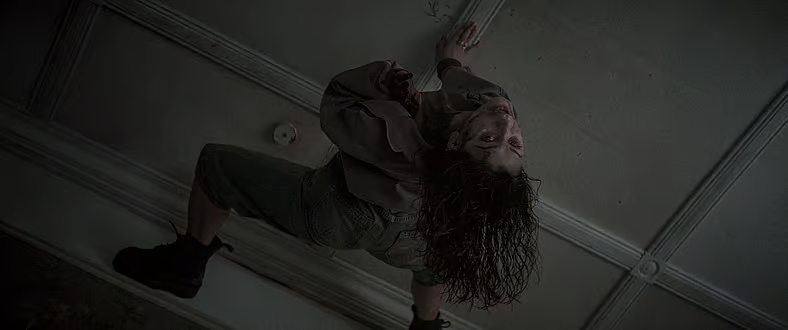
Evil Dead Burn is centered around Alice (Souheila Yacoub), a woman who has found herself trapped in an abusive relationship with her husband, Will (George Pullar). Aside from Will’s younger brother, Joseph (Hunter Doohan), the rest of Will’s family seem to think quite little of Alice. It’s likely due to the fact of how highly esteemed their own image of Will is. Seemingly the golden child, they either remain blissfully unaware, or blatantly ignorant, of his most true self. Considering it takes mere moments after his introduction to reveal how cruel Will is, his family appears to fall into the category of the latter. This frustrating fact makes Will’s sudden funeral all the more unpleasant for Alice. And here, the stylistic and tonal contrasts of the Evil Dead films begin to make themselves apparent within the very text of the film. Whereas Will is described by his mother and grandmother so lovingly, Alice has a much darker and more realistic image of the man. This contrast in individuals and how they’re perceived by the outside world creates a sort of double-image within each character of Evil Dead Burn. It’s the script’s greatest strength, choosing to focus on one half of a character whenever the film deems it most vital. There’s a real unpredictability because of this. Considering the Deadites utilize their excellent knack of turning the horror on and off to best improve their chances at domination and survival, it’s quite fitting within the events of this film. If the outright monsters can feign innocence in order to better infect everything around them, having the humans do the same thing before any Deadite mayhem kicks off is quite telling.
And so, the question persists regarding the driving force of an Evil Dead film. It seems the most apt descriptor would be torment. The original films famously found Raimi tormenting one of his best friends in the world on screen. Seeing Bruce Campbell as Ash get mocked, attacked, and literally tossed around a small cabin for 85 minutes makes for some of the most entertaining cinema one could ever conjure. The torment existed almost literally: the Deadites were hooligans looking to cause as much havoc as possible. When Fede Álvarez resurrected the franchise in 2013, he gloamed the torment of addiction onto the film and its ensemble. It’s a shockingly grim film that leans fully into the horror of the situation, returning to the basics of the franchise while injecting it with a brutality and genre-fueled horror that set the standard for the next decade of horror filmmaking. Evil Dead Rise saw Lee Cronin examining the torment that potentially comes with raising a child amongst a dysfunctional family environment. Here, the torment lies in the complex nature of grief. Alice is ridiculed by Will’s family into becoming a shell of herself, forcing her into a place of subservience in the name of “what’s right” from an idealistic perspective rather than a realistic one. It’s a cruel punishment, and it’s one that instantly gains Alice audience sympathy even if no character is all that interesting in this film.
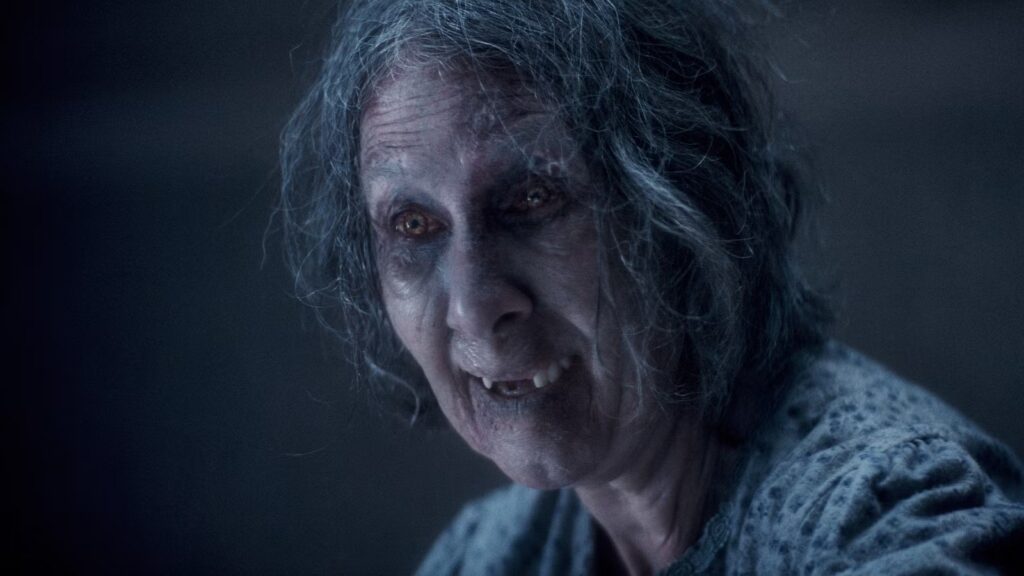
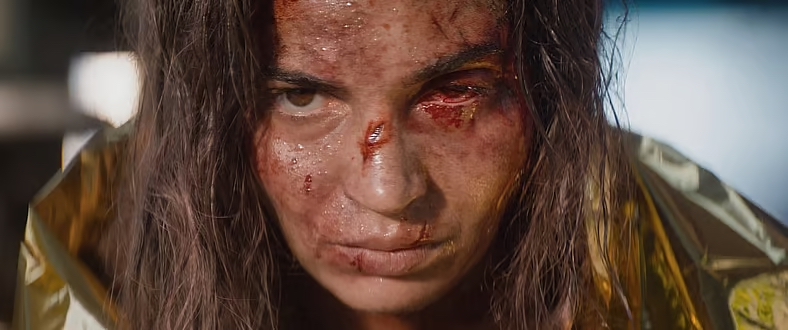
Of course, the torment also lies in how the Deadites interact with any victims within their range. The violence in this film is incredibly gnarly, and it’s dished out in both directions. The heroes of this film are brutalized in every conceivable way. It may not have the silliness of Raimi’s personal touch present, but make no mistake, the lengths at which Vaniček treats these characters is enough to make any horror-lover cackle with maniacal glee at the violence depicted. Despite largely feeling hollow on a thematic level, it’s impeccably well-crafted from a makeup perspective. The visuals of Evil Dead Burn feel largely, and unfortunately, anonymous at times. But in its greatest moments of chaotic violence, Vaniček and cinematographer Philip Lozano can occasionally allow the camera to run rampant in a way that harkens back to the thrilling filmmaking the Evil Dead films should always have as a baseline.
Overall, if this is a film within a franchise revolving entirely around contrasts, Evil Dead Burn finds itself never veering too far away from the center of its own rating spectrum. In some instances, it can be a largely dull film that feels interchangeable with any random horror film within a given year. In other moments, it remains a shockingly mean, fairly enjoyable genre romp featuring Deadites tormenting a small ensemble in a close-quarters setting. It’s the sort of blueprint that makes for an inherently fun time at the movies no matter what. Could a bit of the exposition and lore-building of this film be dropped in favor of a tighter narrative and more compelling characters? It feels like that should almost certainly be the case. But Evil Dead has also always been a film franchise revolving around experimentation. It should be a series that allows filmmakers to approach their entry with a go-for-broke energy that isn’t typical amongst traditional horror films. While this film may not feel as if it was made that way, short of a handful of wonderful shots and sequences, one can only hope that Vaniček and future filmmakers find ways to bring bewildering imagery and airtight scenarios to theaters because of the opportunity a franchise like Evil Dead offers to its audiences and filmmakers alike: the chance to do something different with the same set of tools everybody else has been granted. It’s an exciting prospect that audiences will hopefully show up for time and time again.
Evil Dead Burn is currently playing in theaters.