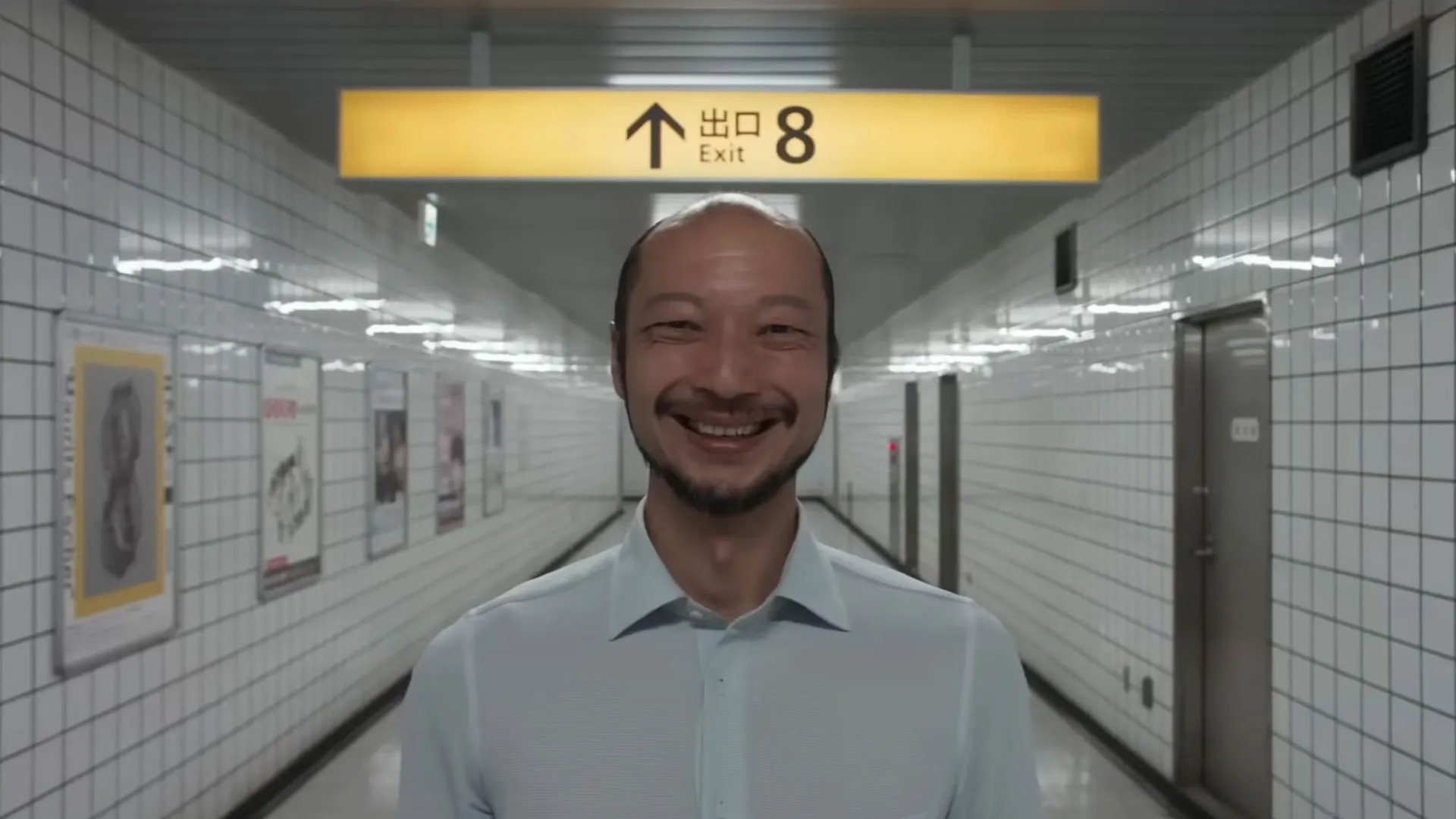
It’s no surprise that Exit 8, a film adapting the video game of the same name, is resonating with contemporary audiences. After all, it relies on a framework explicitly centered around the shared experience of our current isolationist age. Despite being more connected than ever through social media and the marvels of modern technology, there’s a bitter and tragic irony to how far removed many of us have become on individual levels. The shared experience of social media isolating people into their own algorithmically fine-tuned bubbles of reality is one of the more devastating effects of the modern age highlighted in this film. The morning scroll has become far too commonplace for many of us. In an ideal world, it would merely be a way to wake up learning new information or general news, seeing a funny joke, or providing an idea of what the day might behold. But as tech companies become increasingly more predatory and our feeds are consistently filled with hate-mongering and needless violence which threatens to desensitize us to daily horrors, it’s easy to retreat within ourselves and numb anything that distresses us. When discussing the inception of the film, co-writer and director Genki Kawamura noted that he believes we are largely becoming more selfish because of the path modern society has found itself treading down. And through the liminal labyrinth Exit 8 places its characters within, Kawamura is able to explore these ideas in ways both blunt and ambiguous.
That’s all to say the brutal and largely mundane repetition Exit 8 revolves around feels obviously relevant to right now. And all the while it offers so much to explore within the imaginations and interpretations of the viewer. Kawamura utilizes a ton of thematic leeway in adapting a game that largely provides its player a blank slate. Through personal interpretation, that slate allows the imagination of its creator and its audience to run completely wild. Is this scenario that of a punishment? A warning? A test of sorts? Purely devious pleasure for a larger power? Few answers, if any, are ever truly provided. Yet the film is never lacking in terms of closure. Its open-endedness functions as a feature more than it does a bug. Through his small yet effective cast, Kawamura interrogates the varied experiences and changes we encounter across the course of a life: through the eyes of a young man, a child, and an older gentleman. With a virtually identical, repetitive path serving as the single setting of Exit 8, how the world and the people within it are viewed shifts depending on the character centered at any given moment. And the setting of this labyrinth is perhaps what’s most interesting to ponder in the first place.
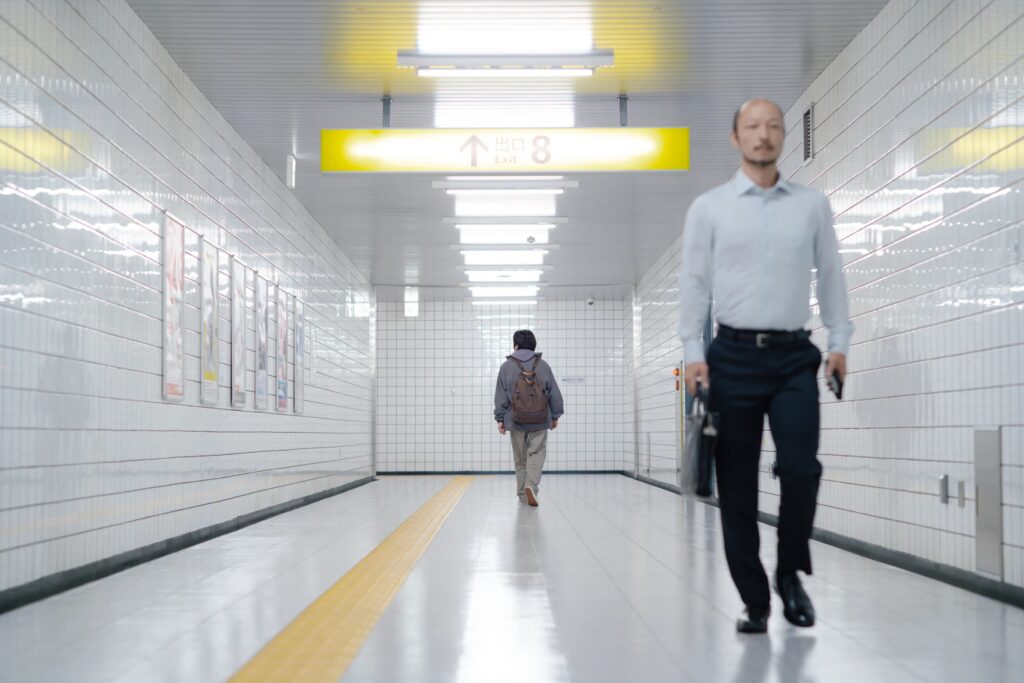
The stark cleanliness and modern angles of this repeating train station hallway are glaring characteristics. It speaks to an incredibly common location that is easily identifiable. But it’s also a space largely associated with crowded foot traffic. To slowly lose all that bustling noise and be replaced by eerie silence, the occasional footfall, or something far more confounding, is wholly effective. In this space, the isolation channeled is practically palpable. The opening of Exit 8, purely on functional and stylistic levels, is wondrous. But it also serves a deeply endearing and respectful purpose: paying complete homage to video game language. Kawamura opens the film with a glorious first-person-POV oner. It’s executed so fluently that some may wonder whether the entire film will be playing out in this style. Slowly but surely, Kawamura allows himself more wiggle room stylistically. Despite fanning out his deck of cards for cinematic techniques to choose from, the space his characters inhabit intentionally shrinks with each new rotation. The rules of this maze are bluntly laid out for the character and viewer as if it’s a literal tutorial. Anomalies, or lack thereof, need to be noticed; the success or failure to do so means level progression or punishment. There’s a ticking clock in the form of The Lost Man’s (Kazunari Ninomiya) inhaler and bottle of water. The personal stakes, beyond his own life, are set via an early phone call. With the dread firmly established and the rules laid out, Exit 8 goes off to the races with a patience that’s tortuous for its characters yet briskly paced for its audience. The faithfulness Kawamura captures this liminal space with is simply a (horrific) joy whether or not the viewer is familiar with the game. That it so effortlessly translates the literal instructions of a video game into cinematic form is a major indicator that earnestly relying on source material can greatly benefit a film. In an era where so much art is bogged down by irony and fear of earnest reverence, Exit 8 is a shining, effective example of the opposite.
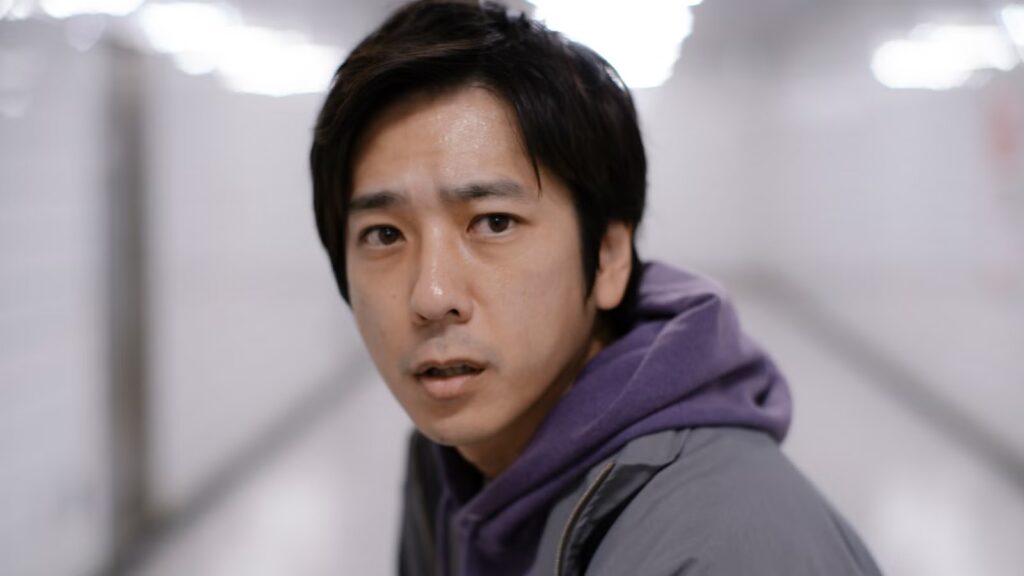
The simplicity of Exit 8 also allows the film all the necessary groundwork to explore its thematic ideas and intentions. We are often so rarely cognizant of the loop-like nature of our regular, everyday lives as they currently stand. For many, life has been largely reduced to the same pattern playing out ad nauseam for weeks, months, or sometimes even years. As a character chillingly exclaims in the film, reality seems like the hellish nightmare we should so desperately want to escape from. And once Kawamura strips away all the distractions of a regular commute, it allows him the opportunity to force his characters and his audience into a sense of hyper-vigilancy. In any horror film, those invested are always going to be scanning every inch of the frame and holding their breath with each new corner approached. Exit 8 demands this attention from all parties involved. Kawamura uses the simple instructions of Exit 8 to interrogate why we have become so oblivious to the world around us. It’s less so an indictment on humanity as much as it is a painful reckoning with how far we’ve fallen as individuals within a larger society. As such, the film forces us to remain eagle-eyed. And even then, some characters and viewers alike will still fail to notice all the anomalies present within any one stage. It’s a fun, and simple, way to encourage active engagement over passive observation. That’s not to say this film is airtight in its delivery, but the point Kawamura is looking to make is validated more often than not, and the film provides itself a lot of leeway in this regard.
The brutal repetitions of Exit 8 can admittedly begin to grind down the audience a bit. Luckily, the film never veers into punishing. With a runtime hovering just over 90 minutes, Kawamura finds a way to pack plenty of wonderful surprises into the film. The repetitions instead are solely meant to torment its characters. As far as horror effectiveness goes, it’s a success. The film is largely one continuously chilling experience. Yet Kawamura finds a way to imbue countless learning moments alongside his more sinisterly-minded genre sequences. It all culminates in a film likely to be remembered quite positively in the years to come. Exit 8, for all the mysticism lurking amidst its looped corridors, ultimately morphs into a startlingly simple reflection of reality. In being trapped amidst nothing but a test forcing us to notice changes we often ignore in favor of looking down at screens, we can begin to realize the selfish errors of our ways. We can walk with purpose looking forward rather than aimlessly stroll along the path laid out in front of us. By striving to notice more, we can become active and engaged members of society rather than a group of passive, isolated individuals stuffed into a small, overheated train car or subway station.