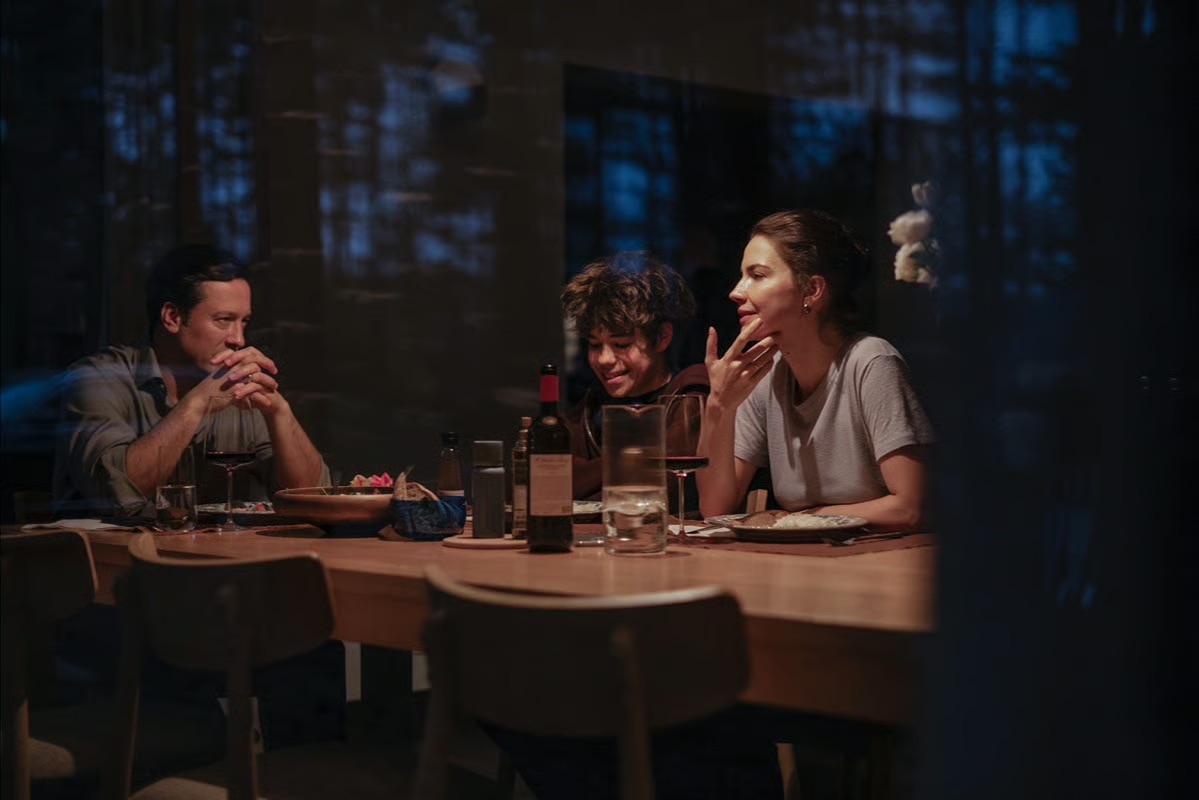
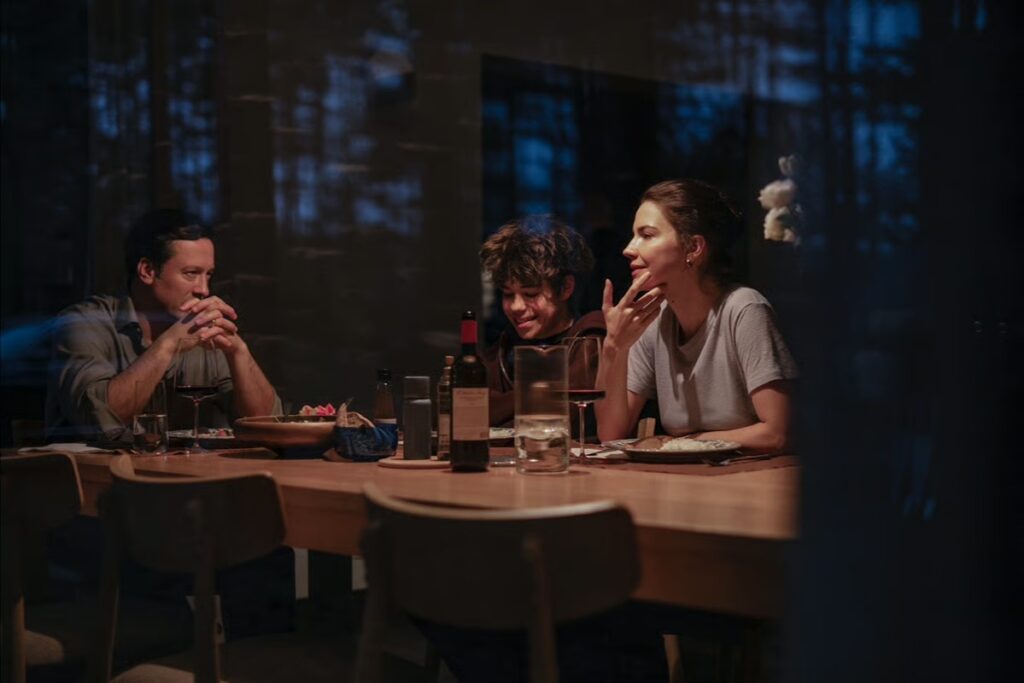
They say first impressions are everything in life. Minotaur, the latest film from now-exiled Russian filmmaker Andrey Zvyagintsev, features two incredibly memorable examples of initial introductions. The first is the audience’s introduction to the Morozov family, the unit at the center of this film. Each member of the Morozov family, be it father, mother, son, or grandmother, seems completely involved in their own personal matters. They might all be passing one another within their beautiful home completely isolated in the woods, but each character is distinctly mulling about with their own specific thoughts or worries. This type of behavior is something that will only continue to escalate over the course of Minotaur, a film being driven by the painful emptiness of its marital drama.
As we spend more time with the Morozov family, so much is revealed through the form of observational cinema. Minotaur is completely centered around two great examples of performances which hinge almost entirely on body language. Gleb (Dmitriy Mazurov) and Galina (Iris Lebedeva) have respectively found themselves completely withdrawn from one another. If the initial tension we meet them in wasn’t apparent enough, it becomes beyond evident in their nighttime routine. There is just a complete lack of love between these two, and at this point, perhaps tolerance is equally missing from their marriage as well. What little we do learn about them reveals the understandable reasoning behind such behavior. Gleb remains fully closed off to Galina as he is willingly drowning himself at work. And yet, he builds up resentment towards Galina in his inability to be selfishly controlling of her life. With only one car to share, Galina relies on him for the occasional ride while he is on his way to work. In return, Gleb merely displays a complete lack of trust in his wife when dropping her off in town. While Galina certainly has her own fair share of not-so-innocent qualities, Gleb is depicted as a cruel man who seems to care more about subservience within his life than romantic love. With so much quiet resentment built up between this husband and wife, Mazurov and Lebedeva’s body language is the only way we are allowed any form of access to their character’s internal selves for so much of Minotaur. Both performances are great in their own right, particularly because of how desperately we want to read further into their decisions and respective micro-expressions. It’s one of the many ways in which Zvyagintsev and co-writer Simon Liashenko encourage their audience to desperately search for meaning amongst all the minutiae in any given scene.
This unknowable tone is what drives the momentum of Minotaur forward as a thrilling crowd-pleaser with a dark, razor-sharp edge. It continuously introduces strands of plot which vanish, until reappearing as a vital piece of the larger portrait that Zvyagintsev is creating. As Gleb and Galina become further entrenched in their walled-off lives, we begin to witness just how easily it is to let corruption seep into every part of our identities. Minotaur even poses the question of whether or not innocence can exist in such a society; one that breeds countless opportunities for rot to fester in truly damning ways. But Minotaur isn’t made up exclusively of people who are acting in their own best interests devoid of any internal conflict. The emotional teetering of the film is what makes its thrills and drama all the more effective.
Minotaur very firmly exists within the Venn diagram of a noir and full-blown thriller. It carries all the timeless qualities of each genre. But this film, although it’s set in 2022, is primarily interested in exploring those genre fundamentals amidst the backdrop of a contemporary political context. To be more specific, Gleb and Galina’s marital troubles bubble up worse as the ongoing war in Ukraine reaches the first of many breaking points. The war here isn’t merely being used as a backdrop to this film. It is explicitly baked into the narrative; the ways in which Zvyagintsev and Liashenko utilize it is beyond chilling. It feeds into the aforementioned notion of rot seeping into every aspect of life. We experience it firsthand through Gleb. He and a few other key business owners in town are rounded up by their mayor with a task that’s both shocking and frightening to ponder: each company must provide a certain number of employees to the military in order for the town to meet their conscription quota. In return, the military won’t swoop in and draft even more civilians without a care. It’s a troubling demand which hangs over so much of the film. It’s one of many developments in Minotaur that reminds the audience just how willing Zvyagintsev and Liashenko are to examine all the ways in which people can lose their humanity to the point of being hollowed out completely.
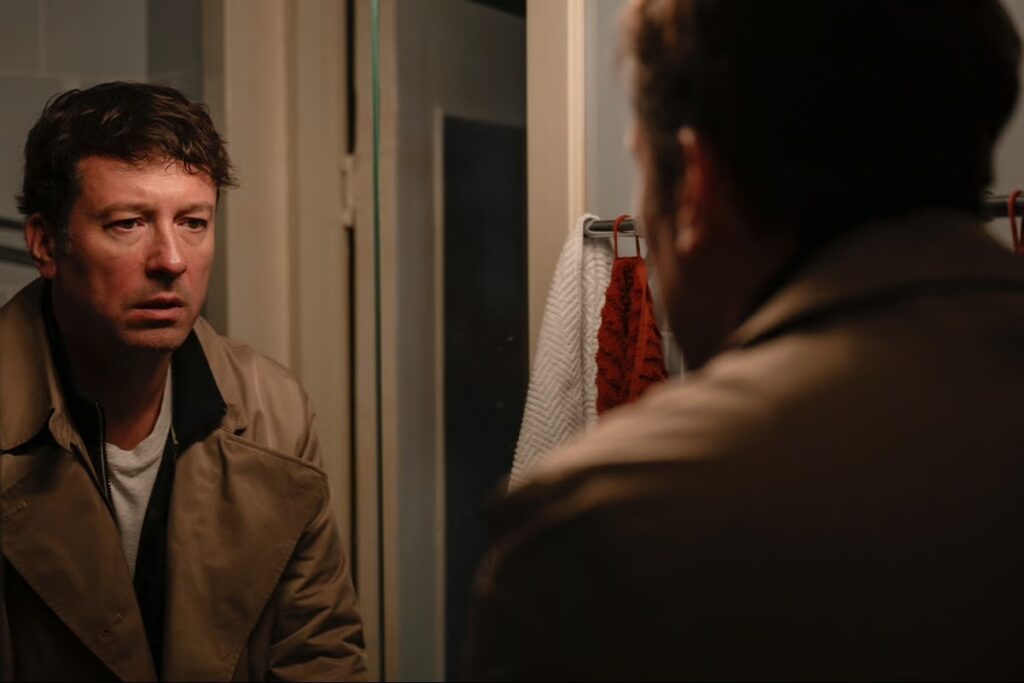
Without spoiling the other first impression tucked away within the patient runtime of Minotaur, it is a key example of this film’s ability to completely shift any built-up notion audiences might have about its pacing or tone. What once felt like a drawn out exploration of family drama quickly becomes a full-blown thriller with tinges of black comedy. Minotaur then becomes a film rife with deadly crime, cruel circumstances, and an unflinching pace that grips its audience tightly with little worry regarding comfort levels. This isn’t a particularly graphic film, but it could be argued that its grotesque ugliness exists in the calculated, ice-cold nature of its characters. There appears to be no moral qualms whatsoever in a majority of the individuals we’re following along as they grapple with their increasingly worsening circumstances. And these characters continue to sink deeper into the abyss of their own making with each passing day. Practically all of Minotaur is built entirely on lies; these lies are utilized in such entertaining fashion for the benefit of the audience. But beyond pure entertainment, Zvyagintsev uses these lies to build the foundation of his criticism against the Russian government and its complete lack of honesty or justice towards its people.
As the Morozov family finds themselves standing atop unsteady ground, Minotaur begins to set the stage for its hollow final act. All of Zvyagintsev’s and Liashenko’s script has built to this particular sensation which burrows uncomfortably into the minds of its audience; the unpleasant depiction of being haunted by all the corruption we have allowed into our lives. As Minotaur barrels towards its finale, Zvyagintsev avoids sentimentality and an ending with more conventional flair. This film operates under the disheartening belief that there may not be any justice in a society built on deceit and immorality. There’s barely even a proper resolution for the inciting incident of the second act, which shouldn’t be taken as a criticism. It instead serves as an indictment of humanity more than anything. However, with such an indictment, there must be some punishment. Many would attempt to escape culpability. It’s something we see earlier in the film as some of Gleb’s fellow CEOs leave the country until “the whole thing blows over.” When their luxurious travel plans are contrasted with reports of thousands of people fleeing their homes for the nearest country borders with little to nothing in tow, it speaks volumes of Zvyagintsev’s frustrations with his own country. And so, Zvyagintsev doesn’t allow his own characters to get off that easily. He instead treats the Morozov family to the notion that it is impossible to hide from the fundamental poisoning so many fall victim to when living in a place that encourages such foul, evil behavior. What should represent ethereal beauty to them is instead warped into something that permeates their souls with a nasty, lingering rot. And the final shot of Minotaur is just that: an extended, haunted image, perfectly embodying the sinking feeling of being poisoned by the decay in society that will ultimately consume our souls should we not act carefully.
Minotaur is celebrating its New York Premiere in the Main Slate section at the 64th New York Film Festival.